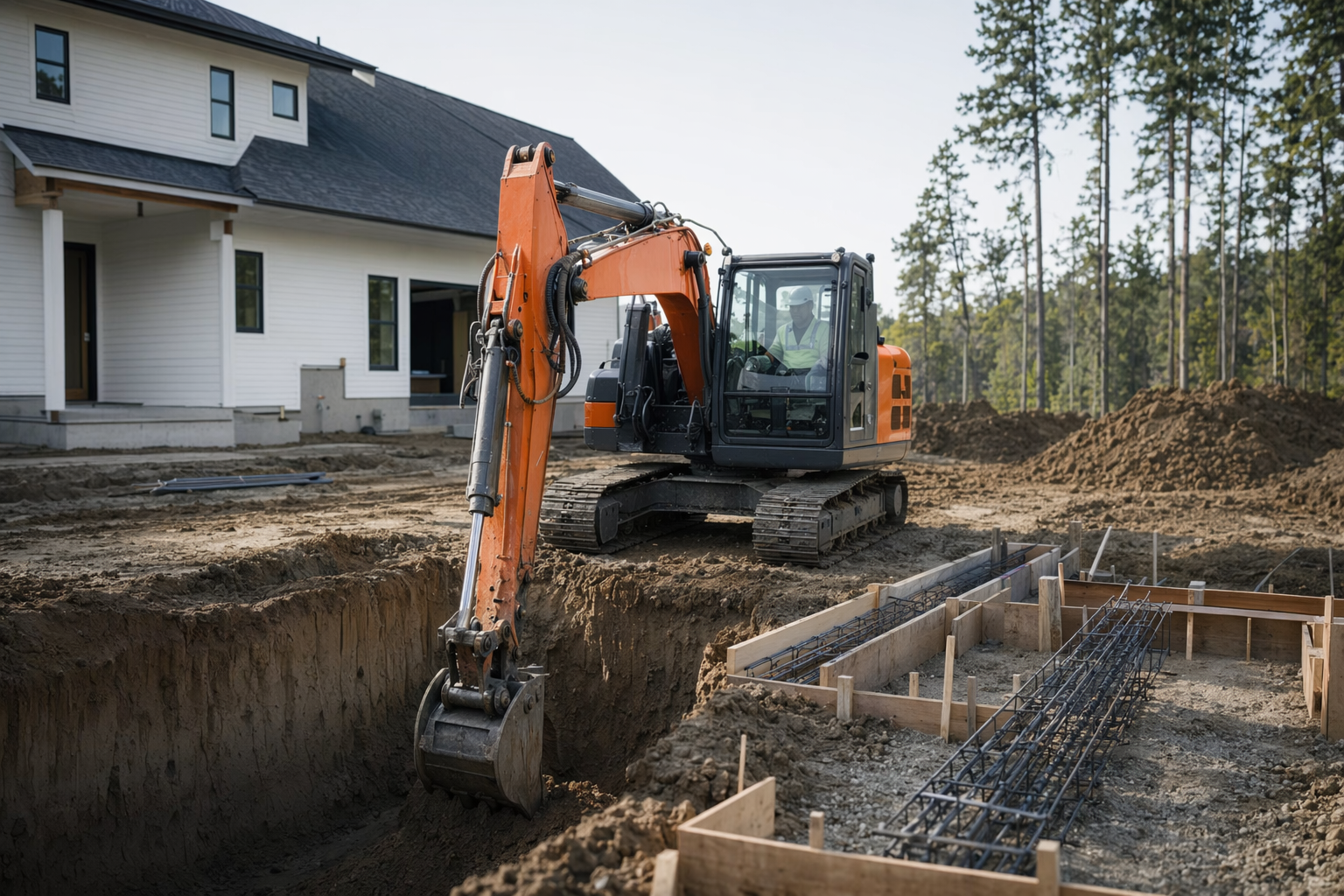
This is the digging needed to build a house foundation or basement at the right size, depth, and slope.
What this work involves
Foundation and basement excavation means removing soil to the plan dimensions and depth for footings, stem walls, crawl spaces, or a full basement. The contractor may clear the area, strip topsoil, cut to grade, shape a building pad, dig footing trenches, and haul off excess dirt. Common equipment includes an excavator, mini-excavator, skid steer, dump truck, and compaction equipment.
This work is not just "dig a hole." The excavation has to match the approved layout, depth, and width so concrete crews can place footings and foundation walls correctly. Soil conditions matter a lot. Loose fill, wet clay, sand, rock, groundwater, and collapsing trench walls can change the approach, equipment, schedule, and cost.
On many projects, the excavation contractor also helps with rough grading around the foundation, backfilling after the walls are in, and compacting in lifts so the soil settles less later. Drainage details may be part of the job too, such as creating positive slope away from the foundation, shaping a swale, setting gravel for a footing drain or French drain, or coordinating erosion control like silt fence.
Safety is a big part of basement excavation. Deeper cuts may need sloped sides, benching, or shoring depending on soil and site conditions. Local rules, footing depth requirements, and frost depth vary by area. Gradeline does not provide engineering or construction advice, but we can help you find licensed, insured, bonded contractors for services like foundation digging and land grading. Always call 811 before any digging so utilities can be marked.
Signs you need it
You typically need foundation or basement excavation when you are building a new home, adding a room with a new foundation, replacing a failed foundation, or converting from a crawl space or slab to a deeper foundation system where permitted. It is also common when a site is sloped and the building pad must be cut and filled to create the right elevation.
A few signs this work may be part of your project:
- Your plans call for footings, stem walls, or a full basement
- The lot is uneven, steep, wooded, or has poor drainage
- The site has soft, wet, or previously disturbed soil that needs rework and compaction
- You need haul-off because there is too much spoil soil to keep on site
- Your builder mentions footing depth, over-excavation, groundwater, or shoring
You may also need an excavation contractor if water tends to collect where the foundation will go, if there is a high water table, or if the lot has rock or hard digging conditions. In those cases, digging can become more complex and may require dewatering, hammering rock, extra trucking, or revised grading and drainage work.
If you are not sure whether your project needs excavation only, grading only, or both, Gradeline can help you understand the basics and connect you with contractors who handle site prep, cut and fill, backfill, compaction, drainage, and related earthwork.
What it typically costs
Typical costs for foundation and basement excavation depend on depth, access, soil, groundwater, rock, and how much dirt must be hauled off. For a straightforward foundation excavation on an accessible site, many homeowners see rough starting ranges around $3,000 to $12,000. Full basement excavation often runs higher, commonly about $10,000 to $30,000 or more when the dig is deep, the footprint is large, or hauling, shoring, or difficult soil is involved.
Projects can move above those ranges if the site needs major cut and fill, imported fill, extensive compaction, dewatering, erosion control, rock removal, or tight-access equipment. Backfill and final grading may or may not be included, so ask for a clear scope. A low number may only cover digging, while another contractor may include layout help, haul-off, stone, drainage, and compaction.
Common cost drivers include:
- Basement size and excavation depth
- Soil type, moisture, and stability
- Need for sloped sides, benching, or shoring
- Rock, roots, stumps, old concrete, or buried debris
- Truck access and distance to dispose of spoil soil
- Backfill material, compaction, and finish grade work
- Drainage items like swales, culverts, or footing drain stone
These are typical ranges, not quotes or guarantees. Local pricing varies. For more detail on earthwork pricing, visit costs. The best next step is to compare written scopes from qualified local contractors and verify exactly what is included.
How to choose the right contractor
Look for a contractor with direct experience in foundation and basement excavation, not just general yard digging. This work affects the concrete phase, drainage, and long-term settlement risk. Ask whether they regularly excavate for footings, basements, crawl spaces, and building pads, and whether they handle backfill and compaction after the foundation is complete.
Before hiring anyone, verify that the company is properly licensed if your state or local area requires it, and confirm active insurance and bond status where applicable. Ask for their full business name, proof of general liability coverage, and whether they use employees or subcontractors. It is smart to verify credentials yourself with the issuing agency or insurer.
Good questions to ask:
1. What is included in the scope: digging only, haul-off, backfill, compaction, rough grade, finish grade, erosion control, drainage?
2. How will you handle wet soil, collapsing trench walls, or groundwater if encountered?
3. Will you protect the site with measures like silt fence and safe access routes for trucks and equipment?
4. How do you measure quantities such as cubic yards excavated, imported fill, and haul-off loads?
5. What equipment will you use, and can you work within my site's access limits?
A strong estimate should explain the plan in plain English and note allowances or exclusions instead of being vague. You can also review how to choose an excavation contractor for a practical checklist. Gradeline is not a contractor and does not give engineering or legal advice, but we can help you connect with licensed, insured, bonded local pros.
Get matched, free
Gradeline is a free matching and education service for property owners. Tell us a few basics about your project, such as whether you need footings, a crawl space, or a full basement, the rough footprint, your timeline, and your contact information. We only collect project and contact details needed to help with matching.
We can help you get connected with vetted local excavation contractors who work on foundation digging, building pads, cut and fill, backfill, compaction, drainage, and related site work. You can compare scope, communication, and availability, then choose the company that feels right for your project.
Before any digging starts, make sure 811 has been called to mark underground utilities. That step matters even on new-looking lots. When you are ready, get matched for free.