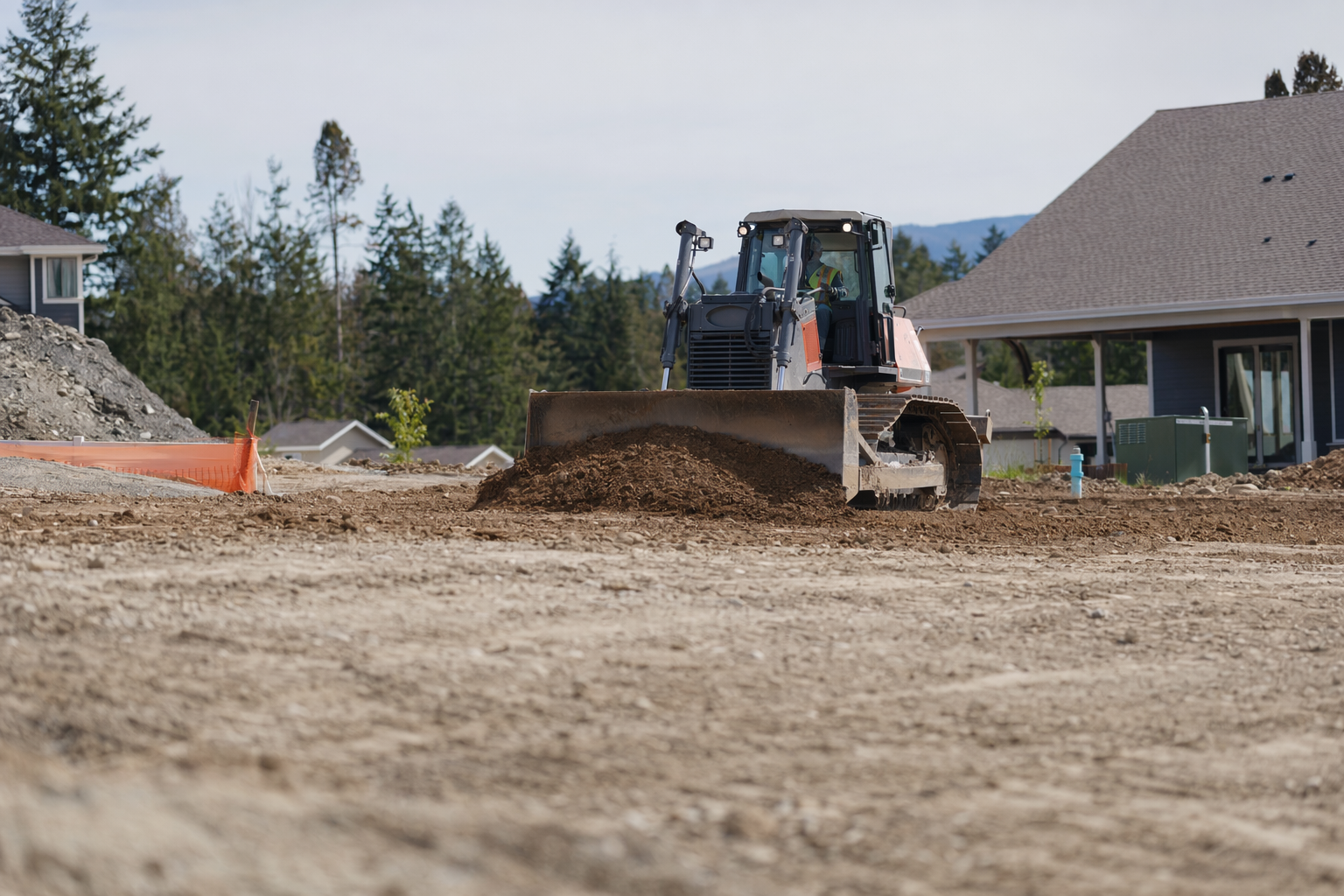
Grading changes the height and slope of your soil so your yard, driveway, or building area sits level where needed and drains safely away from structures.
What this work involves
Land grading and leveling usually means cutting high spots, filling low spots, and shaping the ground to a planned slope. A contractor may use a mini-excavator, skid steer, dozer, or compaction equipment depending on the size of the job. The goal is not just to make land look flat. It is to create the right grade for drainage, stability, and the next phase of work.
Common grading jobs include building pads for sheds, garages, and homes, driveway grading, yard leveling, and correcting drainage around a foundation. Contractors often talk about rough grade and finish grade. Rough grade gets the site close to shape. Finish grade fine-tunes the surface before topsoil, seed, sod, gravel, concrete, or asphalt.
Good grading also depends on the right material. Clean fill may be used to raise an area, while topsoil is typically saved for the upper layer where grass or planting will go. Fill usually needs to be placed in lifts and compacted so it does not settle later. On some sites, the job may also include a swale, culvert, French drain, or other erosion control measures such as silt fence.
If the work is near a house, a key principle is positive slope away from the foundation so water does not collect at the base of the structure. If excavation is deep, near footings, or next to a structure, the contractor may need to address footing depth, shoring, and safety requirements. Always call 811 before any digging so underground utilities can be marked.
Signs you need it
You may need grading if water stands in your yard after rain, flows toward your house, or creates muddy areas that never seem to dry out. Low spots, ruts, washouts, and soggy edges along a driveway are common warning signs. So are basement moisture issues or puddling near the foundation.
Another sign is an uneven area where you want to build or install something. A shed pad, patio area, driveway base, retaining area, or future building pad usually needs a stable, properly graded surface. If the ground is out of level, soft, or poorly compacted, the next improvement may fail early or cost more to fix later.
You may also need grading after tree removal, utility trenching, drainage repairs, or major landscaping changes. In some cases the problem is not the whole yard, but one section that needs cut and fill to redirect runoff. A licensed site-work contractor can evaluate whether simple regrading is enough or whether you may also need drainage features or additional services.
What it typically costs
Land grading and leveling costs vary a lot based on size, slope, access, soil conditions, and whether material needs to be brought in or hauled off. Small touch-up grading for drainage or yard smoothing may run a few hundred to a few thousand dollars. Larger grading for a building pad, long driveway, or major yard reshaping often lands in the low thousands to several thousand dollars more.
Typical costs often rise when the job needs imported fill, topsoil, compaction, erosion control, or haul-off of excess dirt. Steep sites, tight access, rock, wet soil, tree removal, or work around existing structures can also increase cost. If a contractor must install a swale, culvert, or French drain as part of the grading plan, that is usually priced separately or added to the scope.
Many contractors estimate based on equipment time, labor, trucking, and cubic yards of material moved. That is why two jobs with the same square footage can price very differently. For example, a site that only needs finish grade is usually simpler than one that needs deep cut and fill, compaction testing, or imported fill for a stable pad.
Gradeline can help you understand typical ranges and get matched with local contractors, but we do not provide quotes or guarantees. For broader pricing context, visit costs. Always ask what is included, such as grading only, compaction, topsoil, seeding prep, drainage work, and haul-off.
How to choose the right contractor
Look for a contractor who regularly handles site work, not just general landscaping. Grading seems simple, but poor slope and poor compaction can cause water problems, settlement, and damage later. A good contractor should be able to explain rough grade versus finish grade, where water will flow, what material will be used, and how the soil will be compacted.
Ask practical questions before you hire:
- Are you licensed if my state or locality requires it?
- Are you insured and, where applicable, bonded?
- Have you done similar grading for yards, driveways, or building pads?
- Will you bring in fill, remove soil, or both?
- How will you handle drainage, erosion control, and cleanup?
- Will the final grade slope away from the foundation where needed?
- Do I need permits or inspections for this scope?
Get the scope in writing. It should clearly say whether the job includes cut and fill, compaction, topsoil, finish grading, drainage features, culvert work, haul-off, and erosion control like silt fence. If the excavation is deep or near structures, ask how the contractor will handle safety and whether an engineer or local approval is needed. Gradeline does not give engineering, structural, or legal advice, so it is smart to verify local requirements yourself.
Before work starts, verify the contractor's license, insurance, and bond status yourself if applicable in your area. Ask who is responsible for utility locating, then still make sure 811 is contacted before digging. You can also review our guide to choosing an excavation contractor and explore related land grading services.
Get matched, free
Gradeline is a free service that helps property owners understand excavation and land-grading work and get matched with vetted local contractors. We do not perform grading or construction work, and we do not give site-specific engineering, structural, or legal advice. Our role is to help you ask better questions and connect with licensed, insured, bonded professionals where available.
When you reach out, it helps to share the basics: what area needs grading, what problem you are trying to solve, whether water is pooling, whether this is for a driveway, yard, or building pad, and if soil needs to be brought in or removed. Photos, measurements, and a simple description of the slope can help contractors understand the project.
You only need to provide project and contact details so we can help with matching. Do not send financial, ID, or immigration information. If you are ready to move forward, start here: Get matched.