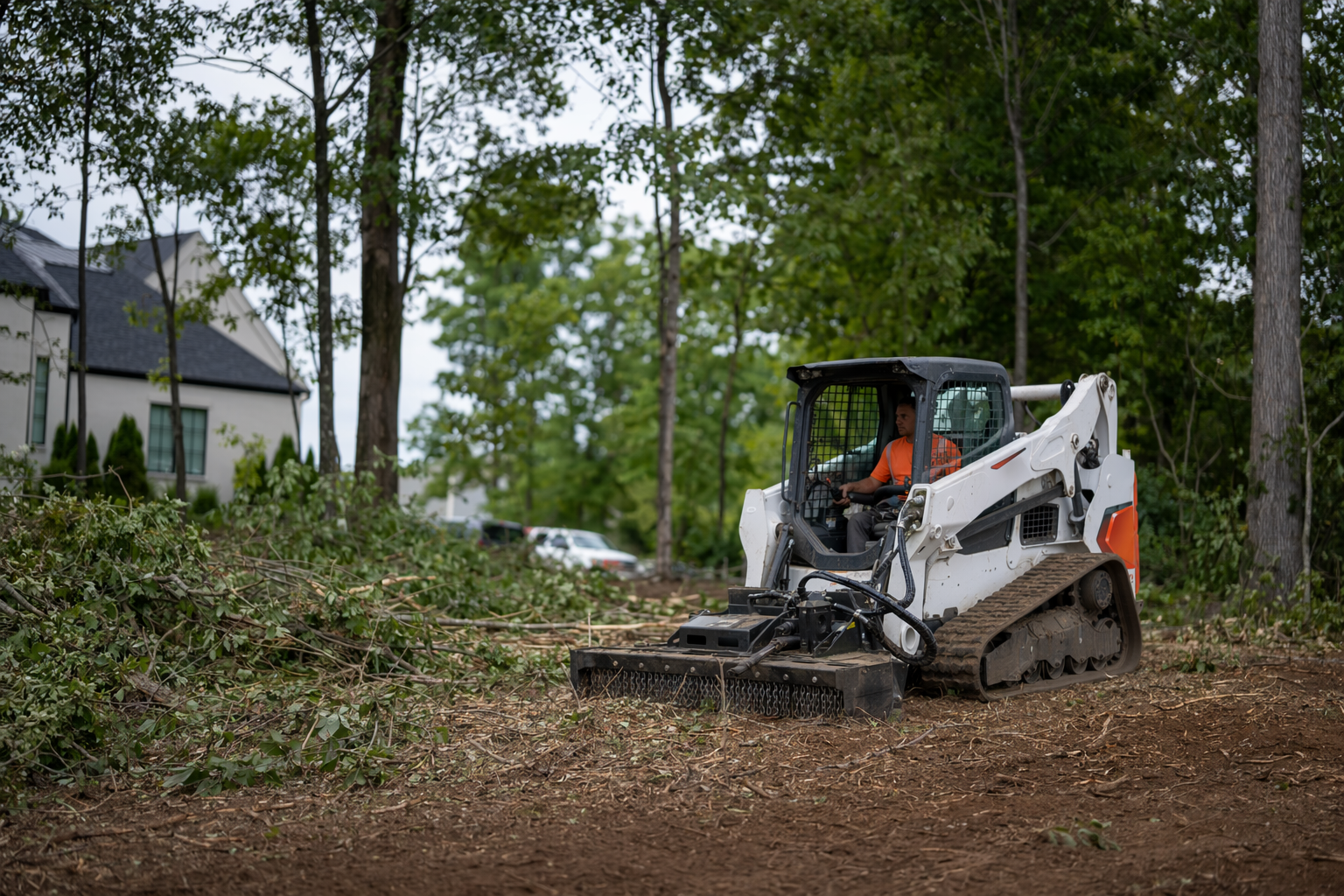
Clearing opens up overgrown land so you can build, improve drainage, or simply make the lot usable.
What this work involves
Land and lot clearing usually starts with a site walk to identify what needs to stay and what needs to go. That can include brush and vine removal, small tree cutting, larger tree removal, stump grinding or stump extraction, and hauling away wood, trash, old fencing, concrete, or other debris. On some properties, clearing also includes removing invasive growth, deadfall, and surface roots that interfere with access or future work.
The equipment depends on the lot and the scope. Contractors may use chainsaws, forestry mulchers, mini-excavators, skid steers, loaders, and haul-off trucks. If the goal is to prepare for construction, clearing is often followed by grubbing, which means removing roots and buried organic material that can rot and cause future settling under a building pad, driveway, or patio.
A good contractor should also think about drainage and soil protection. Bare soil can wash quickly after clearing, especially on sloped lots. That is why erosion control may be part of the job, such as silt fence, wattles, stabilized entrances, or temporary swales to manage runoff. If the project is moving toward land grading, the next steps may include cut and fill, rough grade, finish grade, compaction, and making sure there is positive slope away from the foundation area.
Some clearing jobs need permits or local approval, especially if large trees are involved, the lot is in a protected area, or work is near wetlands, a stream, or a right-of-way. Rules vary by city and county. Before any digging, stump removal, or root pulling begins, always call 811 to have utilities marked.
Signs you need it
You may need lot clearing if the property is overgrown enough that you cannot safely walk it, access it with equipment, or see the boundaries clearly. Thick brush, volunteer trees, poison ivy, and piles of storm debris can make a lot unusable and hide drainage problems, trash, old foundations, or unsafe holes.
Clearing is also common before building a home, garage, barn, driveway, or addition. If you are planning a building pad, footing excavation, septic work, utility trenching, or a new access road, the site usually needs to be opened up first. Contractors often need enough room for machines to work, stockpile topsoil, and haul material on and off the property.
Other signs include recurring pest issues, fire risk from dry vegetation, blocked sight lines at a driveway entrance, and water that ponds because roots, brush, or debris are redirecting runoff. If storms regularly drop limbs and branches across the lot, a cleanup and selective clearing plan can make the property safer and easier to maintain.
What it typically costs
Typical land and lot clearing costs vary a lot because the biggest price drivers are acreage, density of growth, tree size, access, slope, debris type, and whether material is chipped, burned where allowed, or hauled off. Small cleanup and brush-clearing jobs may start around a few hundred to a few thousand dollars. Heavier clearing on part of a residential lot often lands in the low thousands to mid-thousands. Large, wooded, steep, or hard-to-access lots can cost much more.
A few common cost factors:
- Brush and light saplings are usually less expensive than mature tree removal.
- Stump grinding is often cheaper than full stump extraction, but extraction may be needed if grading or building will happen in that area.
- Haul-off adds cost, especially for mixed debris, concrete, trash, or oversized logs.
- Erosion control, permit handling, fence removal, and selective clearing can add labor.
- If clearing is tied to grading, costs may also include topsoil stripping, fill placement, compaction, and drainage features like a swale or culvert.
For larger projects, contractors may estimate by acreage, by machine hours, by the number and size of trees or stumps, or by the expected volume of debris and haul-off. If grubbing and soil preparation are included, they may also think in cubic yards of organic material and spoil being removed. You can learn more about typical site-work pricing on our costs page.
These are typical ranges, not quotes or guarantees. The best way to compare is to get a detailed written scope from licensed, insured, bonded contractors so you can see exactly what is included, what gets hauled off, and whether erosion control and final cleanup are part of the price.
How to choose the right contractor
Look for a contractor who regularly handles land clearing and related site work, not just tree cutting alone. The right pro should be able to explain what equipment they plan to use, how they will protect the areas you want to keep, and what happens to stumps, roots, chips, logs, and debris. If your next step is building, ask whether they understand grubbing, subgrade preparation, and how clearing affects future rough grade and drainage.
Ask for these basics before hiring:
1. License status if required in your area
2. Proof of insurance and bond status where applicable
3. A clear written scope of what stays, what goes, and what gets hauled off
4. Whether permits or tree removal approvals are needed
5. What erosion control they will install and who removes it later
6. A realistic timeline and site access plan
It is smart to verify credentials yourself and ask whether they use subcontractors for tree work, trucking, or disposal. If the lot has steep slopes, retaining concerns, deep cuts, shoring needs, or drainage issues near a future foundation, you may also need input from your local building department or a qualified design professional. Gradeline does not provide construction, engineering, or legal advice, but we do help you ask the right questions. Our guide on how to choose an excavation contractor can help.
And one more time because it matters: always call 811 before any digging, stump extraction, trenching, or grading. Utility lines may be shallower or less obvious than you expect.
Get matched, free
Gradeline is a free service for U.S. property owners. We help you understand excavation and site-work projects and get matched with vetted local contractors for land and lot clearing. We do not perform the work ourselves, and we do not give engineering, structural, or legal advice.
Tell us a few basics about your project, such as the property location, lot size, what needs to be cleared, whether there are trees or stumps, whether you need haul-off, and what you plan to do next with the land. We only ask for project and contact details so we can help with matching. We do not ask for financial, ID, or immigration information.
If you are ready to move forward, start here: Get matched. If you are still comparing project types, you can also browse our services and costs pages first.